Louis Round Wilson Library at UNC Chapel Hill – Photo: Ildar Sagdejev, via Wikimedia
U.S. District Judge Thomas D. Schroeder has issued a preliminary injunction blocking the University of North Carolina from enforcing HB 2, the state law banning transgender people from restrooms that match their gender identity. The federal judge found that three transgender individuals challenging HB 2 are likely to succeed in convincing the court that the law violates Title IX’s prohibitions on sex discrimination in education.
In writing his decision, Schroeder relied heavily on a ruling by the 4th U.S. Circuit Court of Appeals in the case of G.G. v. Gloucester County School Board, in which the 4th Circuit found that Virginia transgender high school student Gavin Grimm would be likely to succeed in his claim that his local school board’s policy on transgender students is discriminatory.
“The fate of G.G. is uncertain,” he said, referring to the Grimm case. “But, despite the stay and recall of the mandate, the Supreme Court did not vacate or reverse the Fourth Circuit’s decision. Thus, while other courts may reach contrary decisions, at present G.G. remains the law in this circuit.”
Schroeder also pushed back against a recent district court ruling out of Texas that blocked the Obama administration from requiring schools to treat transgender students according to their gender identity, noting that, for now, the 4th Circuit’s decision sets a legal precedent.
Several groups, including the American Civil Liberties Union and Lambda Legal, celebrated Friday’s ruling.
“We are thrilled that the court put a temporary stop to some of the grave harm HB 2 imposes on our transgender clients,” Tara Borelli, a senior attorney with Lambda Legal, said in a statement. “This ruling is an important first step to make sure that thousands of LGBT people who call North Carolina home — particularly transgender people — get the privacy, respect and protections afforded others in the state.”
The challenge to the law will be heard in full by Schroeder on Nov. 14. During the trial, the court will hear other arguments against the law, including evidence that it violates Title IX, is unconstitutional under the Equal Protection and Due Process Clauses of the Fourteenth Amendment, and violates the privacy and medical decision-making of transgender people. The court will also hear challenges to the non-bathroom-related provisions of HB 2, such as the part of the law that prohibits local municipalities from passing LGBT-inclusive nondiscrimination ordinances.
“Today is a great day for me and hopefully this is the start to chipping away at the injustice of HB 2 that is harming thousands of other transgender people who call North Carolina home, plaintiff Joaquín Carcaño said in a statement. “Today, the tightness that I have felt in my chest every day since HB 2 passed has eased. But the fight is not over: we won’t rest until this discriminatory law is defeated.”
The Thomas More Society is threatening to sue the Wake County Public School System unless it allows a group of parents to remove their children from a required music class taught by a transgender teacher at Middle Creek Elementary School in Apex, North Carolina.
The right-wing law firm, which advocates for religious exemptions for opponents of LGBTQ rights, sent a letter to the district outlining several additional demands, including written assurances that students will not be disciplined for misgendering the teacher.
The state of Georgia will pay $250,000 to settle a lawsuit filed by a former Georgia Southern University employee who was fired last year after opposing the rollback of LGBTQ-friendly policies and outreach initiatives.
Gemma Skuraton, Georgia Southern's former director of student wellness and health promotion, sued the Board of Regents of the University System of Georgia and Dr. Shay Little, the university’s vice president for student affairs, in her individual capacity in April.
Skuraton alleged that her firing violated her First Amendment and Title IX rights and constituted illegal retaliation for opposing sex-based discrimination, which she argued includes discrimination based on gender identity.
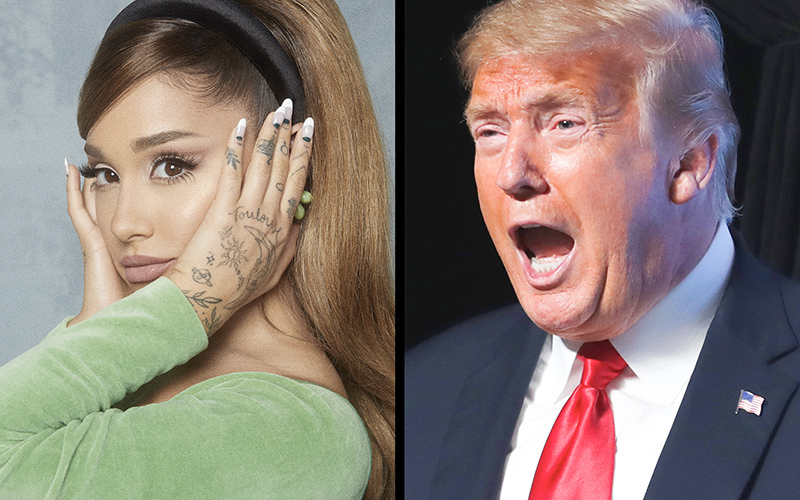
For the second time this summer, Ariana Grande has rebuked President Donald Trump's administration for using her music in a social media post.
The latest dispute erupted after the Team Trump account added Grande's 2024 hit "We Can't Be Friends (Wait for Your Love)" to a TikTok post that repurposed one of its lyrics.
The post quotes the lyric "Me and my truth we sit in silence..." before adding: "...men can't have babies and should never compete in women's sports."










You must be logged in to post a comment.