Same-sex couple with wedding ring. – Photo: Syda Productions, via Dreamstime.
On Thursday, 39 Republicans in the U.S. House of Representatives voted along with all of the chamber’s Democrats to approve a bill to protect same-sex marriages, representing a drop in support among elected Republicans from July, when 47 of them voted for a more liberal version of the legislation.
As passed on Thursday, the Respect for Marriage Act would require the federal government and individual states to recognize same-sex marriages as valid, even if the Supreme Court reverses its 2015 ruling striking down bans on same-sex nuptials as unconstitutional.
The bill also contains protections for interracial marriage, bans on which were outlawed in a 1967 Supreme Court case using much of the legal rationale used to justify the overturn of bans on same-sex marriage.
Yet despite the inclusion of language providing additional religious protections — language, it should be noted, that was requested by Republican U.S. senators as a condition of earning their support — the number of House Republicans supporting the marriage equality bill dropped when the lower chamber was asked to approve the Senate language.
In total, 10 members who supported the measure in July, when it lacked substantial religious protections, either switched their votes or failed to vote on the Senate version of the bill in December — even though expectations were that the enhanced protections for objectors to same-sex marriage would lead more lawmakers to back the measure.
Reps. Adam Kinzinger (Ill.) and Lee Zeldin (N.Y.) did not vote on the measure, while Rep. Burgess Owens (Utah) voted “present,” despite the other three members of the Utah delegation voting in favor of the bill.
Seven other members flipped their votes from “yes” to “no”: Reps. Cliff Bentz (Ore.), Mario Diaz-Balart (Fla.), Brian Mast (Fla.), Dan Meuser (Pa.), Scott Perry (Pa.), Maria Elvira Salazar (Fla.), and Jeff Van Drew (N.J.).
Two other Republicans who previously voted “no” changed their votes to “yes”: Reps. Jamie Herrera Beutler (Wash.) and Mike Gallagher (Wis.), the latter of whom changed his position after it became clear that the language in the Senate version would not open the door to legalizing polygamous marriages, according to Axios.
The other 37 Republicans who remained consistent in supporting legal recognition for same-sex marriages between July and December were:
Just ahead of formally securing the Democratic nomination earlier this week, U.S. Rep. Sarah McBride (D-Del.), the first out transgender member of Congress, announced her intention to run for a leadership role within the House Democratic Caucus.
In a September 14 letter, McBride asked her House Democratic colleagues to support her bid to become a co-chair of the Democratic Policy and Communications Committee, which develops messaging for the caucus.
Axios congressional reporter Andrew Solender shared a copy of the letter on X, writing: "Rep. Sarah McBride makes it official: She's running for leadership. Specifically co-chair of House Democrats' messaging arm."
Democratic U.S. Rep. Eugene Vindman cursed at a constituent and walked out of a meeting with party activists after transgender attendees challenged his vote for a Republican-backed "forced outing" bill.
The confrontation occurred on August 11 in King George County, a heavily Republican locality at the eastern end of Vindman's 7th Congressional District that overwhelmingly favored President Donald Trump in 2024.
Vindman, a swing-district Democrat, attended the King George Democratic Committee meeting to rally party loyalists behind his reelection bid. After discussing Trump, affordability, and the midterm elections, he took questions from the audience.
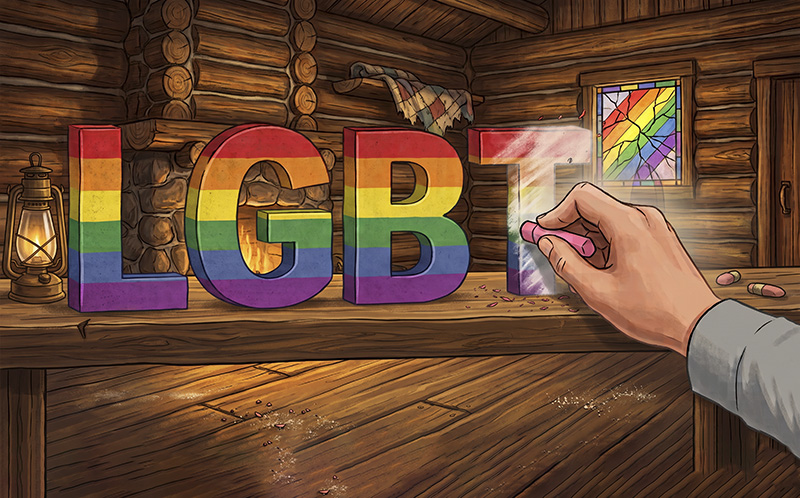
The board of directors of Log Cabin Republicans, a gay conservative political advocacy group that touts itself as dedicated to "building a more inclusive GOP," announced that it was dropping support for transgender rights from its mission.
Since its founding in the late 1970s, the group has promoted conservative values and policies -- grounded in the constitutional principles of equal protection under the law, limited government, and individual freedom -- while advocating for equal rights and fairness regardless of sexual orientation.







You must be logged in to post a comment.