
‘The Colored Museum’ Speaks Truth with Lacerating Wit (Review)
Studio Theatre revives George C. Wolfe's pungent satire "The Colored Museum" in a hilarious new production.

Studio Theatre has resplendently re-opened The Colored Museum, George C. Wolfe’s biting survey of Black American history, myth, humor, and representation in art and culture.
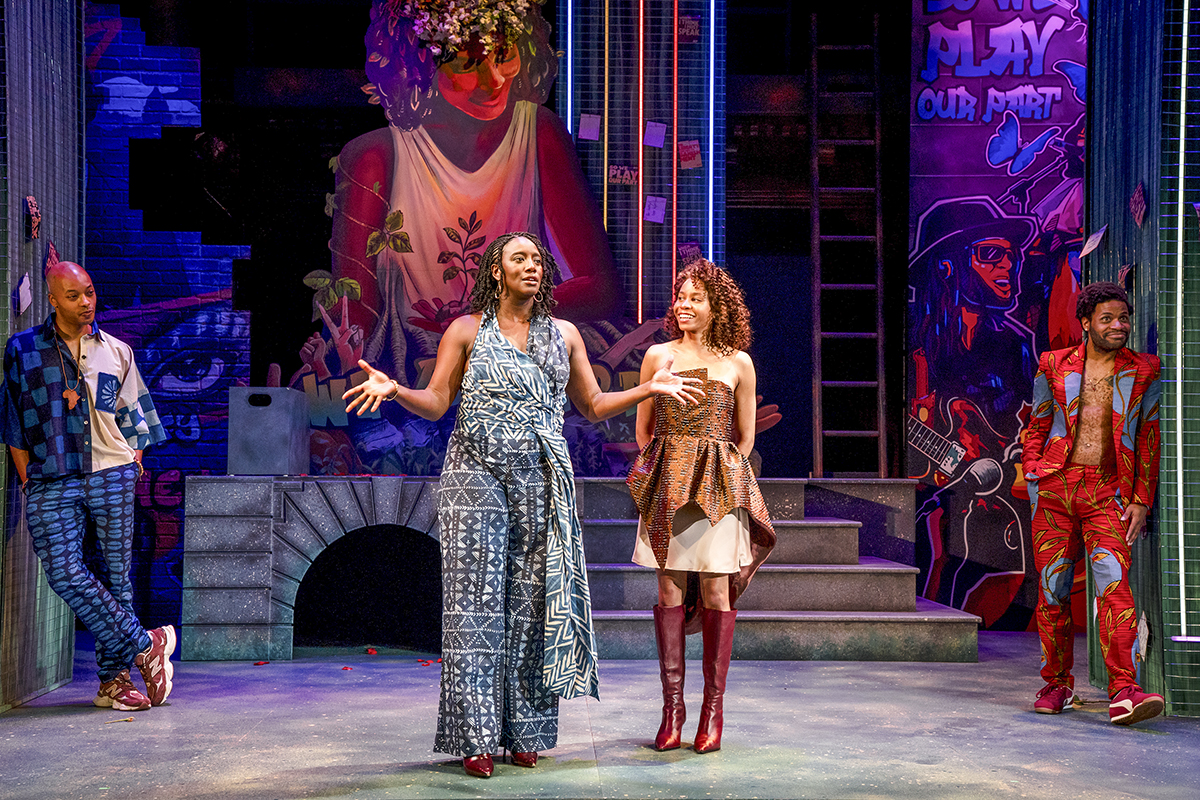
The entrance and stage of Studio’s Victor Shargai Theatre comprise the galleries, displaying artifacts on the play’s themes, created by students from the Duke Ellington School of the Arts.
Works hung inside the theater, and even the seating, envelope the audience within Psalmayene 24’s environmental production, shrewdly designed by Natsu Onoda Power.
The prime exhibits on view at the Colored Museum are eleven brilliantly-written sketches encompassing centuries of Black lives, since African ancestors arrived in America as cargo, up to the modern age of so-called liberation. On ages of perceptions and misconceptions, Wolfe’s stories speak truth with lacerating wit, and subvert stereotypes with deceptive ease.
It takes a quick company to keep up, and Psalmayene — who’s been impressively busy and beautifully productive across four different shows this past season — has assembled an ensemble that’s up to the task, and always in on the joke.
Not everyone in the house will be sure when to laugh as the exhibits dip fearlessly into discomforting waters. “Fasten your shackles,” warns flight attendant Miss Pat (Ayanna Bria Bakari), in preparation for the first sketch, our hazardous voyage across the Middle Passage aboard the Celebrity Slave Ship.
“And please ignore the drums,” she adds. But the drumbeat travels the Middle Passage with us, of course, carries us through every chapter, every exhibit — literally, in the form of percussionist Jabari Exum, a masterful presence onstage.
Presence only begins to describe the myriad qualities Kelli Blackwell brings to multiple roles throughout, including in the incendiary TV spoof “Cookin’ with Aunt Ethel.” Grinning wide, Aunt Ethel stirs up a saucy recipe for her viewers, with “rage” and “attitude” among the spicy ingredients. What could she be cookin’ up?
The taste surely will be bittersweet, as is most of the comedy, riding somewhere between silly and seething, and calibrated to perfection by Blackwell, Bakari, Iris Beaumier, and William Oliver Watkins in “The Last Mama-on-the-Couch Play,” the evening’s best of a murderer’s row of great sketches.
An absolutely hysterical parody of all the sorts of stereotypical stage drama Black theater talent have felt confined to, “The Last Mama-on-the-Couch Play” finds this ensemble firing at their sharpest.
And, juxtaposed with solid solo sketches like Matthew Elijah Webb’s powerful turn in “The Gospel According to Miss Roj,” and duos like Webb and Watkins doing “Symbiosis,” the Mama-on-the-Couch sketch highlights how fluidly Psalmayene moves the revue through its many transitions, setups, genres, and emotions.
The ensemble ends the Mama-on-the-Couch sketch belting gospel, hitting subtle notes of humor, courtesy of composer Kysia Bostic. The notes could have been less subtle, technically, with better amplification for the vocalists.
Although, judging subtlety as it pertains to satire will probably depend on how one empathizes with the pain and rage and attitude that underscore all the humor.

In the ridiculous but oh-so-profound sketch “The Hairpiece,” a single lady (Blackwell) is confronted by her two outspoken wigs — one an Afro (Beaumier), the other long, straight, and flowing (Bakari) — over not just which hair to wear, but what kind of Black woman she must be.
In “Symbiosis,” Watkins portrays a man who’d trash any and every connection to his Blackness — his records, his Afro pick, his first pair of Converse sneakers — in order to get ahead.
Does making progress — advancing the race, as they used to say — require killing off past selves, abandoning who you were for what you aim to be?
Or, are we all better off if we preserve even the painful reminders, keep that history safe, well-curated, and conveniently close, so someday, hopefully, we can look back from a better place and laugh?
The Colored Museum (★★★★☆) runs through Aug. 11 at Studio Theatre, 1501 14th St. NW. Tickets are $40 to $95, with discount options available. Call 202-332-3300 or visit www.StudioTheatre.org.
More from Metro Weekly:



Support Metro Weekly’s Journalism
These are challenging times for news organizations. And yet it’s crucial we stay active and provide vital resources and information to both our local readers and the world. So won’t you please take a moment and consider supporting Metro Weekly with a membership? For as little as $5 a month, you can help ensure Metro Weekly magazine and MetroWeekly.com remain free, viable resources as we provide the best, most diverse, culturally-resonant LGBTQ coverage in both the D.C. region and around the world. Memberships come with exclusive perks and discounts, your own personal digital delivery of each week’s magazine (and an archive), access to our Member's Lounge when it launches this fall, and exclusive members-only items like Metro Weekly Membership Mugs and Tote Bags! Check out all our membership levels here and please join us today!



You must be logged in to post a comment.