Parents of a transgender teenage boy have asked an Ohio family court to stop their child from receiving hormone therapy, reports CNN.
The 17-year-old boy, whose name has been kept anonymous, took his parents to court in order to be able to receive treatment for gender dysphoria at Cincinnati Children’s Hospital Medical Center. The teen suffers from anxiety and depression related to his gender dysphoria, and began experiencing suicidal ideation after his parents refused to acknowledge his gender identity.
The boy has been living with his maternal grandparents while the court battle rages on. But the teens’ parents have asked that the child continue living with his grandparents, even if the court decides that the parents are the ones who should make choices about whether the teen pursues his transition.
Karen Brinkman, an attorney representing the parents, says that it is in the teen’s best interest to continue living with his grandparents, though the parents are best suited to retain custody and make medical decisions for their child.
Brinkman maintains that the teen’s current mental state hinders him from making an informed decision about his health care.
“It does not appear that this child is even close to being able to make such a life-altering decision at this time,” she said.
The grandparents have previously told the court that they are willing to allow their grandchild to receive treatment for gender dysphoria, including hormone therapy, if it is deemed medically necessary.
In 2016, the teen was hospitalized and treated for gender dysphoria. But his parents put a stop to the therapy, citing religious objections and a desire to seek out a Christian therapist to help their child deal with his feelings.
In November 2016, the teen told a local crisis hotline that his father had told him to kill himself. The teen also claims that his parents made him sit in a room and listen to Bible scripture for over six hours in an effort to purge him of his feelings of gender dysphoria. A month later, the teen claims he tried to read a letter to his parents explaining his feelings, but his mother screamed at him and called him a liar. Eventually, the parents relented and allowed him to resume counseling-type therapy to deal with his suicidal ideation.
The boys’ medical providers at Cincinnati Children’s say that the boy has improved mentally and emotionally from his therapy, and that the grandparents have created a supportive environment. But the medical team believes that starting hormone therapy and other treatments will help the teen transition more smoothly.
A Kansas judge has temporarily blocked the state from enforcing its law banning minors from accessing non-surgical transition-related treatments such as hormones or puberty blockers.
On May 15, Judge Carl Folsom III of the State District Court in Douglas County granted a temporary injunction blocking the state from enforcing the law, finding that it likely violated parents' rights to make decisions about their children's health and wellbeing.
In his 117-page ruling, Folsom -- who was appointed by Democratic Gov. Laura Kelly -- wrote that transgender children were likely to suffer "irreparable harm" if the ban on transition-related hormonal treatments remained in effect. He also cited testimony asserting that gender-affirming, non-surgical treatments for minors are safe, effective, and medically credible.
An 18-year-old man was arrested at Cedar Point, the storied, decades-old amusement park in Sandusky, Ohio, for pulling down the skirt and underwear of a transgender woman.
The incident occurred around 8:30 p.m. on May 26. According to a Sandusky Police Department report, a security officer was flagged down by a Cedar Point guest, a transgender woman, who said she and a transgender friend were preparing to leave the park when a man approached her friend from behind, grabbed her skirt and underwear, and pulled them down, exposing her buttocks and genitals.
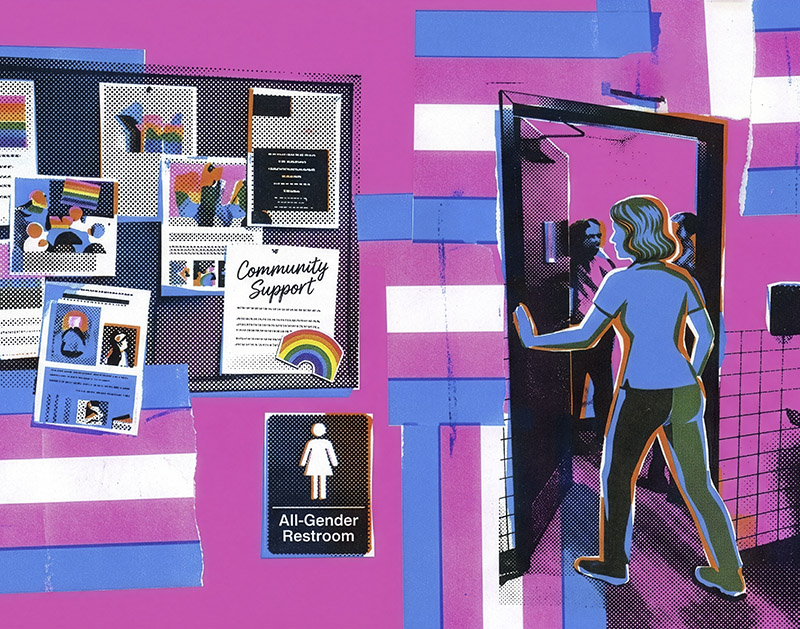
A federal judge has granted a preliminary injunction blocking Idaho from enforcing a law that could penalize transgender people with up to five years in prison for using public bathrooms that do not align with their assigned sex at birth.
The law, known as HB 752, was set to take effect on July 1 after being signed by Republican Gov. Brad Little earlier this year. However, the injunction bars police from enforcing the law's bathroom restrictions. It does not apply to similar restrictions on access to changing rooms, which the lead plaintiffs -- six transgender Idahoans -- have not challenged.
These are challenging times for news organizations. And yet it’s crucial we stay active and provide vital resources and information to both our local readers and the world. So won’t you please take a moment and consider supporting Metro Weekly with a membership? For as little as $5 a month, you can help ensure Metro Weekly magazine and MetroWeekly.com remain free, viable resources as we provide the best, most diverse, culturally-resonant LGBTQ coverage in both the D.C. region and around the world. Memberships come with exclusive perks and discounts, your own personal digital delivery of each week’s magazine (and an archive), access to our Member's Lounge when it launches this fall, and exclusive members-only items like Metro Weekly Membership Mugs and Tote Bags! Check out all our membership levels here and please join us today!










You must be logged in to post a comment.